
Monthly Financial Reports Every Contractor Should Review
Contractors don’t need more numbers. They need financial information that helps them understand what is happening in the business. Consistent monthly reports can provide a clearer view of profitability, cash, expenses, receivables, and the financial direction of the company.
The right reports turn bookkeeping records into information a contractor can actually use to ask better questions and make better-informed decisions.
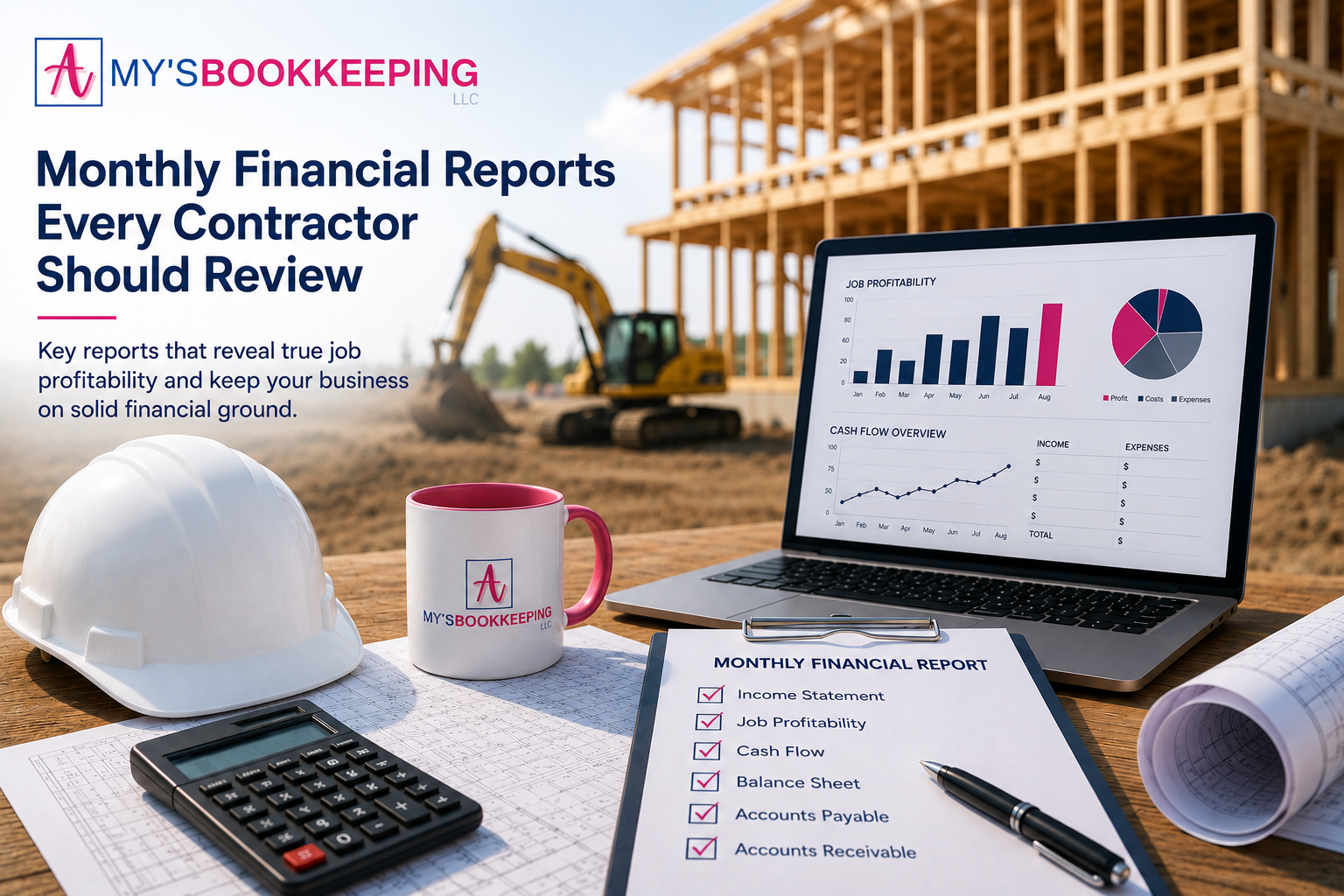
Financial Reports Should Help You Understand the Business
A contractor can stay extremely busy without having a clear picture of the company’s financial performance. Jobs are moving, customers are paying, materials are being purchased, subcontractors are being paid, and new work continues to arrive.
Monthly financial reports organize that activity into a more useful picture. Instead of relying primarily on the current bank balance or how busy the schedule feels, owners can review what the numbers are showing across the business.
1. Profit and Loss Statement
The Profit and Loss statement — often called the P&L or income statement — summarizes revenue and expenses over a period of time and shows whether the business produced a profit or loss.
Revenue
How much income the business generated during the reporting period.
Expenses
What the company spent to operate and support its work during that period.
Profitability
What remained after the reported expenses were deducted from revenue.
Looking at the P&L consistently can help a contractor notice changes in revenue, expenses, and profitability rather than discovering those changes months later.
2. Balance Sheet
While the Profit and Loss statement shows financial activity over a period, the Balance Sheet provides a snapshot of the company’s financial position at a particular point in time.
It generally organizes what the business owns, what it owes, and the owner’s equity in the company. Reviewing it regularly can reveal changes that may not be obvious from the P&L alone.
Assets
Resources associated with the business, including cash and other recorded assets.
Liabilities
Financial obligations recorded by the business.
Equity
The owner’s financial interest in the business after liabilities are considered.
3. Accounts Receivable Aging
Revenue on a report does not necessarily mean the money is already sitting in the bank. Contractors may have completed or billed work while still waiting for customers to pay.
An accounts receivable aging report helps show who owes the company money and how long those invoices have remained outstanding.
What it can reveal
Outstanding invoices that may need attention before they quietly become much older receivables.
Why contractors should care
Materials, payroll, subcontractors, and operating expenses may need to be paid before all customer payments have arrived.
That timing difference is one reason a profitable construction company can still experience cash pressure.
4. Job Cost and Project Profitability Reports
Company-wide profitability matters, but contractors also need to understand what is happening at the project level.
When the bookkeeping and job-costing system is structured appropriately, project reporting can help compare revenue and costs associated with individual jobs. That can make it easier to identify where labor, materials, subcontractors, equipment, or other costs differ from expectations.
Reviewing completed jobs can also provide useful information when estimating and pricing future work.
5. Cash Flow Information
Profit and cash are related, but they are not the same thing. A contractor can show a profit while experiencing a shortage of available cash because receipts and payments occur at different times.
Looking at cash alongside receivables, upcoming obligations, project activity, and profitability can give owners a more complete view than simply checking today’s bank balance.
A bank balance tells you how much cash is there today. Good reporting helps explain why.
That distinction becomes increasingly important as a contracting business takes on more projects and larger financial commitments.
The Reports Become More Useful When You Compare Them Over Time
A single month’s report is useful. A consistent series of monthly reports can be considerably more informative.
Contractors can begin to see whether revenue is increasing, expenses are changing, receivables are aging, margins are tightening, or cash patterns are becoming less predictable.
The goal is not to turn every contractor into a financial analyst. It is to provide enough consistent information to recognize changes and know when a question deserves attention.
Good Reports Depend on Good Bookkeeping
A polished financial report is only as useful as the records behind it.
Transactions need to be categorized consistently. Accounts need to be reconciled. Project-related expenses need to be handled appropriately. Receivables need to be current enough to mean something.
When the underlying bookkeeping is inconsistent, the report may look official while still giving the owner an incomplete or confusing picture.
A Practical Monthly Reporting Routine
Contractors do not necessarily need to spend hours analyzing financial statements. A consistent review can begin with a handful of practical questions.
Did revenue or expenses change noticeably?
Significant changes deserve an explanation rather than an assumption.
Are customers paying on time?
Review outstanding receivables and identify invoices that are getting older.
Are jobs performing as expected?
Compare available project information with estimates and expectations.
Does the cash picture make sense?
Consider available cash in the context of receivables, expenses, obligations, and current project activity.
Monthly Bookkeeping and Reporting for Contractors & Trades
Amy’s Bookkeeping LLC helps contractors and trades businesses maintain organized books, consistent monthly records, and financial reports that are easier to review and understand.
Reliable reporting begins with reliable bookkeeping. A steady monthly process helps turn the financial activity of a busy contracting business into information the owner can actually use.
Financial Reporting FAQs for Contractors
What financial reports should a contractor review each month?
Useful reports can include the Profit and Loss statement, Balance Sheet, accounts receivable information, and job or project reports when the bookkeeping system is structured to provide them.
Why isn’t the bank balance enough to understand the business?
A bank balance shows available cash at a moment in time but does not by itself explain profitability, unpaid customer invoices, liabilities, or project performance.
Why should contractors review reports monthly instead of only at year-end?
Monthly review can help owners recognize changes while they are still current rather than discovering them after many months have passed.
Do financial reports replace job costing?
No. Company-wide financial statements and job-level reporting answer different questions and can be more useful when reviewed together.
Turn Monthly Bookkeeping Into Useful Financial Information
Amy’s Bookkeeping LLC helps contractors maintain organized records and consistent monthly reporting so they can see more clearly where the business stands.